Collier Legal Search

Blogs

2022 Hiring Trends

2022 Hiring Trends

As the new year begins, law firms are still reeling from a skilled worker shortage brought on by a strong economy, the lasting effects of pandemic layoffs, and the great resignation. In May 2021, there were 8,268 open positions for lawyers across the United States, a 150% increase from early 2020. This is not surprising when reports of mass resignations are paired with increased corporate demand for legal services. The result of the trends catalyzed by the global pandemic is that 2022 will continue to be an applicant’s job market. Firms need to use their hiring budget to develop employee-friendly characteristics, like flexible work schedules, to attract qualified employees. Law firms also need to invest in technology that supports hybrid working models. If companies can implement successful hiring changes, there is significant potential for business growth. Demand for legal services is high, and the job market requires firms to invest in new hire recruitment. Learn the 2022 hiring trends and how to get the best talent for your firm. Candidate Driven Market Applicants have the advantage in a job market when there are a lot of available openings. Since workers are not threatened by the prospect of a long job search, they are willing to leave their job for another one. 2021 saw significant increases in employee turnover in professional services, with quitting rates per month increasing from 2.9% in 2020 to 3.7% in 2021. At the same time workers were leaving their jobs, the demand for legal services was at a record high, resulting in the few applicants applying for positions vying for higher salaries. There were more mergers and acquisitions in the first half of 2021 than in the past 20 years. In addition, the pandemic created a backlog of cases that firms have started to work through as courts open in-person hearings and make virtual hearings more efficient. Emphasis on Valuing Employees and Accommodating Their Needs If law firms want to maintain or expand their client pool in 2022, they need to stand out to potential employees by putting them first. The candidate-driven job market affords candidates too many opportunities for firms to offer average job packages and expect them to come on board. Firms need to accommodate the new job ideal that most young professionals seek. It is characterized by improved employee experience via company culture and work flexibility. Job seekers will assess their employment options based on the company culture and whether the working environment benefits them emotionally, mentally, and physically. Create and Support a Strong Employer Value Proposition (EVP) Employer Value Proposition (EVP) is the promise you make to legal talent about what your firm and the job offers. A strong EVP includes more than pay, benefits, and training. An EVP that works as a recruitment tool also lists company culture distinctions, the job’s role in the company’s goals, and the differences between your firm and the competition. Writing a compelling EVP is one thing, but your firm has to support your EVP for top talent to sign on and stick with you. Consequently, firms invest more in recruitment packages and employee retention services like flexible working arrangements. Work Flexibility The recent shift to at-home work uncovered the potential for workplace flexibility, and workers want this to continue. 84% of workers want the option to work from home, so a firm without a remote work option is at a hiring disadvantage. The most attractive firms for current candidates invest in quality training that allows employees to work successfully in the office, remotely, or in a hybrid model where they work from home a few days a week. Firms with freelance opportunities also expand their candidate pool by attracting applicants who don’t want to be tied down to a single company or position. Technology’s Role in Hiring and Retention AI or automated computer systems are gaining prevalence in the legal industry because they make firms more efficient, are compatible with remote work, and improve the client transfer process. As lawyers find new jobs and bring clients with them, it is more important than ever to have efficient client transfers. AI client transfer systems remove manual steps, like document accumulation, so that a firm’s attorneys can focus on billable work rather than clerical work. The AI systems also afford new hires the flexibility to work at home because their client transfers no longer require effective communication and collaboration with the client and new firm. Connect with Candidates at Collier Legal Search 2022 has the potential to bring significant growth to law firms and provide workers with jobs offering lucrative benefits. The hiring trends are based on candidates having the upper hand in the labor market, so if firms want to capitalize on the growing demand for legal services, they need to offer significant perks to candidates. Firms can use the legal staffing recruitment services that Collier Legal Search provides to connect with the best legal talent for their open positions. Collier Legal Search has 17 years of legal placement experience and can quickly fill your firm’s temporary or permanent openings. Contact us today with any questions about our placement services.

2022 Hiring Trends Read More »

How 2021 Shaped the Legal Industry

How 2021 Shaped the Legal Industry

2021 brought its share of challenges and successes to the legal industry. The reopening of businesses and economic growth created a need for more legal consultations. The rise in legal cases created a higher demand for skilled legal staffers, which are currently in short supply.  Here’s how 2021 shaped the legal industry.  Increases in Litigation, M&A, ESG Law Many industries, including legal, slowed down in 2020 due to the emergence of the COVID-19 pandemic. As businesses started reopening, the legal industry has seen higher demand for services in litigation, mergers & acquisitions (M&A), and environmental, social, and governance (ESG) law.  Many litigation cases were put on hold during the pandemic, creating a backlog of cases being dealt with now. There has also been a rise of corporate legal issues directly related to the COVID-19 crisis. These legal issues include: Commercial and contract disputes Data security  Fraud, bribery, or corruption Bankruptcy  Interruptions of businesses due to COVID-19 There is an increased need for legal services when the economy is doing well, especially for businesses going through M&As. Many companies stay competitive by acquiring new revenue streams or mergers with other companies. They may want to develop their supply chain further or scale their business efficiently after experiencing problems during the pandemic. Many businesses are incorporating ESG interests during their decision-making process. ESG covers environmental and social concerns and the ethical standards governing the rights and responsibilities of a company. Businesses are looking for ESG experts to ensure they comply with policies and prepare their ESG disclosures. Reporting ESG helps companies boost their reputation and build trust in their industry and consumers. Hiring Challenges The pandemic created new problems and shortages across many industries, and the legal field was no exception. Many law firms furloughed workers or downsized their firms during the start of the pandemic. Now, as restrictions ease, firms are beginning to grow again as business picks back up.  Law firms need to hire more staff but are facing challenges because skilled legal workers are in short supply. Shortages of legal workers developed during the pandemic due to layoffs and workers choosing to stay at home. Other legal workers left the industry entirely, feeling overwhelmed or unprepared by the increasing responsibilities of their job. Currently, 58% of the legal industry is experiencing the strain of not having enough skilled workers. Increases in corporate litigation, M&A, and ESG cases have also contributed to the shortage. More lawyers with the skills or experience are needed to meet current demand. The hiring process has also changed as a result of the pandemic. Many interviews are conducted virtually instead of in person. Lawyers are applying for positions across many regions and may be more selective about where they choose to work since they are in high demand. Health and Safety Concerns The health and safety concerns of lawyers brought on by the pandemic have changed how lawyers and law firms conduct business. More firms and lawyers work remotely and even conduct meetings, court cases, and arbitration hearings virtually. Law firms were able to succeed through the pandemic while working virtually, and many firms have opted to remain virtual or use a hybrid work method. Law firms have had to adjust how their workplaces operate to comply with changing OSHA standards to protect the wellbeing of their staffers. Law firms are responsible for upholding policies on wearing masks, vaccine requirements, and guidance for in-person work to keep all employees safe.  Incorporation of AI Technology With more staff working remotely, firms have incorporated newer technology to assist with their work. AI-based technology helps lawyers handle clients and their cases and directly handle administrative and processing tasks.  AI technology helps lawyers with cases related to intellectual property, cybersecurity, and the misuse of AI. This technology also provides better communication with clients by translating dense legal terminology, answering client questions, and translating documents into other languages. Lawyers and other legal staff use AI technology to save time. AI can process thousands of documents quickly and search for specific content or organize files by type. It helps improve the speed and quality of a firm’s legal services. How Collier Legal Search Helps While 2021 has brought its share of challenges, there has also been steady growth in the industry. Higher caseloads mean greater demands on legal staff.  Law firms can take advantage of current opportunities by using a legal staffing recruitment service to help find additional legal staff for their busy teams. Consider hiring through a legal recruiting company such as Collier Legal Search.  Collier Legal Search team provides professional legal placements for our clients. Our experienced staff will do the legwork to find qualified legal recruits, whether you need staff attorneys, legal administrators, or general counsel. We can help you find a temporary or permanent placement to fit your needs. Visit our website to learn more about the services we offer.

How 2021 Shaped the Legal Industry Read More »

AI Legal Solutions Help Customers

AI Legal Solutions Help Customers

Cyber Security, Data Privacy and Beyond In the 1990s and early 2000s, advances in computer technology and the Internet have changed nearly every industry. Technology has become more integrated into everyday life, with humans adapting to changes like communicating with Siri or Alexa. Today, the new frontier is artificial intelligence (AI) and machine learning (ML), and the legal sector is just one of many fields that will benefit from these new developments. Discover how artificial intelligence (AI) can help connect customers with legal experts, what AI does for law today, what it could do in the future, and why law firms should consider investing in AI technology. How AI Legal Solutions Help Customers Most people seeking legal help have little to no understanding of the terminology used in legal documents. AI-based solutions can help clients decipher the more complex legal terms, simplifying the contents of their documents. In turn, the AI tool may determine how a lawyer can help, significantly streamlining the client onboarding process. Often, these solutions come with easy-to-use, recognizable interfaces, such as the popular AI chatbot system. These solutions leverage AI technologies, known as Natural Language Processing (NLP), Robotic Process Automation (RPA), and Machine Translation (MT). These technologies power a legal AI’s ability to perform the following tasks: Processing client questions and providing context-sensitive, personalized responses Reducing the time spent scanning legal documents for relevant words and sentences (known as the legal discovery process) Offering document translations in multiple languages, facilitating access to legal aid for traditionally underserved groups, and combating marginalization How the Legal Industry Engages with AI Today Currently, the legal industry engages with artificial intelligence in two ways. It works with AI indirectly (through cases and client concerns) and directly (uses of AI by law firms). Indirect Engagements Cases involving artificial intelligence today typically relate to cybersecurity, intellectual property, and the dangers of AI misuse. The increasing prevalence of AI-powered solutions has highlighted new challenges in IP litigation and cybersecurity cases. As more industries use and leverage AI, the more the legal framework surrounding their use will change. Law firms specializing in these cases are responding by building expertise in AI and preparing for future regulation. An example of what these regulations could look like can be found in the Federal Trade Commission’s guidance regarding AI usage or the European Union’s proposed Artificial Intelligence Act. Direct Engagements Besides cases and regulatory changes surrounding AI, law firms also engage with AI directly, leveraging AI-powered tools to facilitate specific administrative and data processing tasks. The primary strength of artificial intelligence is processing large amounts of information. In the legal industry, AI tools excel at reviewing thousands of documents per second, searching their contents, identifying keywords, and categorizing them by relevance. Examples of AI’s applications include: Improving the speed and quality of the due diligence process Assisting lawyers with contract review and helping them offer better counseling Leveraging Predictive Analysis (PA) for legal forecasting, analyzing past case law for patterns, and predicting legal outcomes Time tracking tools and Optical Character Recognition (OCR) expedite the billing process and help eliminate invoicing errors. Concerns and Issues with AI As with every new technology, there are concerns regarding its adoption in the legal industry. Although few experts believe that AI will replace lawyers or judges, there are growing worries about AI tools taking in-house jobs, such as paralegals or legal assistants. Others believe that AI will make the legal industry less empathetic and people-focused, especially since large corporations like Facebook implement many AI applications. Interacting with a chatbot or using an AI tool is not the same as a human-to-human relationship, leading many people to fear that lawyers relying on these tools will be less interested in communicating with their clients. AI is also fraught with overall concerns regarding data privacy, cybersecurity, and other issues typical of new technologies. Because AI is suitable for processing large amounts of potentially sensitive or privileged data, many data privacy concerns exist. For example, if a law firm relying on AI is targeted by a cyberattack, all the information the AI can see could be stolen or leaked. Why Legal Firms Should Invest in AI Although the 2020 ABA Legal Technology Survey Report reported that only 7% of law firms use AI-based tools, this percentage is expected to increase. If used correctly and in conjunction with the human element, early adoption of AI can introduce many significant benefits. AI is scalable; adopting AI tools today allows law firms to familiarize themselves with the technology progressively. Today, it is suitable for mundane tasks; tomorrow, it may assist lawyers with critical work. AI-powered task automation reduces human errors, saves time and money, and allows law firms to use their educated workforce more efficiently. Letting AI focus on traditionally time-consuming and repetitive tasks allows legal personnel to focus on human-to-human interactions. This improves the quality of legal counsel and connects you with more clients. AI technologies can add significant value to the highly educated members of the workforce at law firms, allowing them to serve their clients better. Collier Legal Search Connects You with Quality Professionals Whether or not your law firm plans to adopt AI, the legal industry will always need a human element to function. Collier Legal Search can connect you with the highly-skilled and talented individuals you need on your legal team. Call us today at (713) 863-8180 for assistance with finding qualified legal staff.

AI Legal Solutions Help Customers Read More »

Filling The Gap Between Experience & Availability

The rise of corporate litigation, stemming from the COVID-19 pandemic, created a corporate law attorney shortage in the U.S. This shortage is more significant in Texas because several big corporations now call the state home. With many law offices and in-house corporate attorney positions available, businesses are looking for qualified candidates. Explore the corporate law attorney shortage issue and find out how Collier Legal Search can help fill the gap between experience and availability. The Rise in Corporate Litigation Post-Covid In the wake of COVID-19, a rise in corporate litigation has swept the legal industry. Issues put on hold during lockdowns are moving ahead quickly. Also, new concerns that arose directly from the COVID crisis are being brought into litigation. Issues include: Data privacy issues Commercial disputes Bribery and corruption Business interruptions brought on by COVID Fraud Bankruptcy Contract disputes The rise in corporate legal issues has caused a spike in in-house litigation hiring and spending to keep up with demand. In addition, there is a demand for outside legal representation in corporate matters by businesses involved in litigation. Big Business in Texas The corporate attorney shortage is hitting Texas business hard. Several big-name corporations have recently moved their headquarters to the Lone Star State to take advantage of our excellent quality of life. The steady climate, favorable income tax laws, low cost of living, and access to global markets with well-developed infrastructure are attractive. The list of companies that have made Texas their home include: Oracle Hewlett Packard Tesla Dropbox 8VC Firetrail Amazon Named the Best State for Business by the country’s top CEOs for the 17th year in a row, the emerging corporate landscape has shaken up the Fortune 500 lists in major Texas cities. Now, the big players include information technology companies along with oil and gas corporations. Rising Demand for Corporate Law Attorneys While corporate growth is positive for the Texas economy, it has created challenges in the legal sector. With the national increase in corporate litigation cases, Texas has a shortage of corporate law attorneys. The shortage, which began before COVID-19 in Texas, has grown with the pandemic. The corporate growth of the Houston and Dallas metro areas has led to many businesses searching for legal candidates to handle the increase in legal litigation. Lack of Experienced Corporate Law Attorneys It isn’t just the number of corporate law attorneys that is lacking; it is the experience required to handle the complex corporate litigation required by big-name players. Mergers and acquisitions within the oil and industry sector are creating the need for highly skilled corporate law attorneys in large numbers. Many corporations look to grow their in-house corporate law staff, while others look to outside law firms. Although the number of local attorney firms is growing, it has not yet caught up to the rate of its corporate counterpart. Reports estimate that the available number of lawyers has stayed relatively stable since the Great Recession in 2008. Many in the legal field feel that since 2018, the legal need in Texas has grown rapidly, almost overnight, leaving a gap between the availability of lawyers and their expertise, especially in high-stakes corporate law. Filling the Gap Between Experience and Availability To fill the gap between the shortage of corporate law attorneys for businesses in Texas and available, experienced candidates, companies can utilize the services of Collier Legal Search, a full-service legal recruiting agency that pairs you with experienced candidates. Our team of former legal assistants, paralegals, trial attorneys, and entrepreneurs understands the importance of meeting your company’s specific legal needs, as well as how to assess candidates for corporate law positions. If you cannot find a corporate law attorney to represent you, work with Collier Legal to find a placement to handle your cases with legal expertise. Find out how Collier Legal Search can help you find a candidate to meet your needs. Collier Legal Search Connects Attorneys and Businesses Collier Legal Search connects your business with qualified corporate law attorney candidates, so you are covered for all your legal needs. We have built a network of experienced legal candidates to find you the right person. Contact Collier Legal Search today to get started.  

Filling The Gap Between Experience & Availability Read More »

Pursuing the Strategic Advantage Post Covid

Despite the continuing pandemic, there are many economic opportunities available. Merger and acquisitions (M&As) are exploding at rates unseen in decades, and strong GDP and CPI data show an economy holding steady. The booming economy means an increased need for legal consulting, especially for companies dealing with M&As. Collier Legal Search can help you find qualified legal professionals if you want to further your firm’s growth. Future Opportunities for Value Creation While many companies are presently pausing to determine where the opportunities for value in their business lie, consider these three areas : Growth Companies must seek inorganic growth to stay competitive, particularly by developing their tech and innovation advantages. Companies recognize that this requires expanding revenue potential rather than cutting costs. For example, Panasonic identified its competitive advantage in the shared supply chain sector. They acquired Blue Yonder, Inc, a software developer specializing in supply chain management, in a $7.1 billion deal to develop this area. Scalability Companies seek to scale up in size and reach, influencing the types of deals they pursue, particularly for large corporations, which seem to be more efficient and have access to more capital. These deals involve strategic tie-ups, such as the $30 billion mega-deal between the Canadian National Railway and Kansas City Southern to create a shipping rail system directly connecting Canada, the US, and Mexico. Disruption Disruption refers to an increased commitment to technology as businesses strive to remain relevant in the involved industry. One-third of global deals were grounded in technology, media, and telecommunication industries in the first half of 2021 as companies sought to expand their competitive advantages in those areas. Private equity funds (PE), on the other hand, invested heavily in resilient markets such as healthcare and technology, which experienced the most market disruption during the pandemic. PE investors also pursued investments in new markets such as work-from-home (WFH) and distance learning that reflect long-term behavior changes created by the pandemic. PE investments also targeted Environmental, Social, and Governance (ESG) as the market becomes increasingly focused on net-zero, sustainability, wage inequality, diversity, public safety, and privacy issues. Increase in Available Funds and Affordable Financing Means More (and Bigger) Deals There have been more M&A deals in the last six months than in any other year. Globally, there were 28,175 deals between January 1st and June 30th, with US deals up 264% from last year. There are a few reasons for this growth, all involving an abundance of easy-to-access capital for investments. Interest rates remain low and steady, meaning investors have access to cheap capital they can use to pursue inorganic growth opportunities. Special Purpose Acquisition Companies (SPACs) exploded in early 2021, with over 274 formed. While the SEC announced new financial reporting guidelines in April, slowing down the rate of SPAC creation, about half a trillion dollars needs investment before 2023. A strong stock market means target acquisitions can get a high price, allowing them the luxury of shopping deals. PE companies with large portfolios have rebounded from the pandemic faster than smaller ones. They have benefitted from the strong stock market, allowing them to divest through IPOs earlier than expected and generate more funding. Possible increases to the capital gains tax in the future mean people with capital are seeking to invest it now. Many industries hard hit by the pandemic, such as airlines and cruise lines, face cash liquidity problems and may need to restructure through M&A to survive. Financial Deals Are Adapting The pandemic changed human behavior, which meant financial deals needed to change as well. Uniquely structured investments are becoming more common. Real Estate With the shift to WFH and flexible co-working spaces, tenants have gained power from the property owner. Tenants can now enact more protection into their lease through limited rent escalation and possible rent rate reduction if an economic shutdown impacts the tenant’s income. Shifting real estate deals are not unique to the commercial sector. The National Association of Realtors released a report asking for a “once in a generation” response to the underinvestment and underbuilding of the housing market, resulting in a more than five million unit shortfall since 2020. Rise of the Mega Deal While all M&A deals are up in the first half of 2021, billion-dollar deals have seen the most significant increase, with more than 500 individual billion-dollar deals so far. Many mega-deals, especially those involving large amounts of capital, involve multiple PE investment companies, such as the deal between Blackstone, The Carlyle Group, and Hellman & Friedman acquiring Medline Industries in a $30 billion deal. Collier Legal Search Can Help You Adapt Collier Legal Search is uniquely qualified to use its expansive network to help you find associates, partners, or legal professionals as you build your firm’s corporate law capacity through long-term solutions or contract help. Contact us to help you find the perfect qualified applicant today.

Pursuing the Strategic Advantage Post Covid Read More »

Gen Z Legal

Changes Gen Z Brings to the Legal Workforce

Generation Z, otherwise known as “Zoomers,” live up to their name. Zoomers grew up in a fast-paced, technological world, and, as a generation, they value diversity, financial security, and an open-minded, progressive outlook toward controversial subjects. As this generation begins to hit their early 20’s, law firms are looking to understand what changes Gen Z will bring to the legal landscape. Gen Z employees can benefit the workplace with these unique attitudes and expectations. They value personal connections and aren’t afraid to put in long hours when they feel appreciated. The changes Gen Z brings to the legal workforce are progressive and help older generations to remain forward-thinking. It is beneficial for potential employers to understand what motivates Gen Z employees so they can do what it takes to attract them into the legal workforce. Collier Legal Search focuses on providing you with quality Generation Z candidates to diversify your workforce and help you implement progressive ideas that are characteristic of this group of workers. What is Gen Z? Generation Z is a group of people born between about 1997 through 2012. They are characteristically associated with being tuned into technology, particularly cell phones and social media. Gen Z has come to age in the aftermath of 9/11 and the Great Recession of 2008, making them more conservative in financial matters than other generations. They are known for being outspoken about political beliefs and value social justice and environmental conscientiousness. Despite being hyper-connected to smartphones and social media, Gen Z highly appreciates connectivity in both professional and personal relationships. They also respect and support those struggling with issues related to mental health. Gen Z Workplace Expectations Generation Z is the first generation to grow up in a wholly digital world. They are often referred to as “digital natives” and are comfortable with fast-paced, changing technologies in the workplace. This ease with technology influences many of their career-related expectations. Gen Z workers typically expect the following of their employers: Proactive communication Transparency of company operations and management decisions Clear expectations of job parameters Meaningful evaluations and communications Direct, consistent feedback on job performance Diverse workforce Inclusive, collaborative work environment Updated technology and implementation of digital tools Opportunities for career development Flexible hours Authenticity Employers that positively impact the community Why is it Important to Attract Gen Z Employees? Currently, there are approximately 75 million “Boomers” nearing retirement. Although Generation X and Millennials have stepped into these vacancies, there will be considerable gaps in employment in the coming years. It will fall on Generation Z to fill the roles left behind by the Baby Boomers. Therefore, it is vital to attract and maintain Generation Z employees by adapting workplace operations and policies to match these new workers’ expectations. Not only is it essential to attract Gen Z for logistical reasons, but it is also important because Gen Zers represent a shift in thinking on a global societal scale. It is beneficial for the company to embrace the positive changes they bring to the legal workforce regarding diversity, inclusivity, education, and progressive mindsets. How Can You Appeal to Gen Z Workers? Appealing to Gen Z workers is necessary to embrace future generations and forward-thinking legal practices. To attract Gen Z employees who will stay long-term and work hard for your firm, start implementing several changes to your workplace. Show that your firm cares about the environment and social change with demonstrable acts. Gen Z candidates will respect your firm for speaking out on social justice matters or taking on cases that protect marginalized groups in society. Offer flexible schedules and positions. Implement digital tools and offer remote working options to accommodate new modes of work. Be authentic and honest with Gen Z employees, and give them consistent, helpful feedback on how they perform at work. Encourage meaningful collaboration between teams at your firm and foster an environment of professional yet personal connectedness. Collier Legal Connects You to the Gen Z Workforce If you are looking to bolster your firm’s legal team with qualified Gen Z employees, Collier Legal Search can help. We will search for qualified candidates who fit your job descriptions and work with you to establish employment expectations for our Gen Z candidates. We want to match you with potential employees who meet your needs and will be a positive addition to your firm. Collier Legal Search: Your Key to Working With Gen Z If your firm wants to bring in employees from the “Zoomer” generation, partner with Collier Legal Search to find quality candidates for your legal team. We work to present you with candidates that fit your firm’s needs and specifications. We are committed to the success of our clients and employment candidates. Contact the Collier Legal team at (713) 863-8180 to discover how we can aid you in diversifying your team with excellent candidates from Gen Z.

Changes Gen Z Brings to the Legal Workforce Read More »

Boom of ESG

Boom of ESG in Legal Consulting

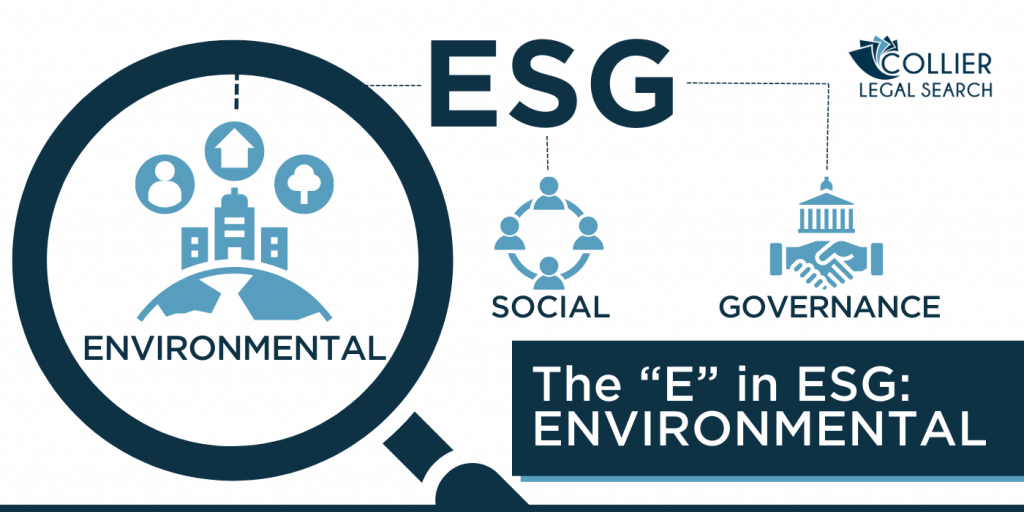
Recent years have seen a boom in ESG (Environmental, Social, and Governance) in legal consulting. ESG factors are continually growing in importance to businesses, investors, customers, and suppliers, and the trend shows no signs of stopping. Expected to continue for many years, corporations and law firms are now hiring their own armies of ESG experts, consultants, and advisors. Globally, ESG has taken hold as a central concern in corporate, financial, and legal entities to such a degree that to neglect ESG integration in your business is likely to lose you customers and jeopardize your competitive advantage. The financial industry in the United States today has already fully incorporated ESG, with younger investors, in particular, fueling the development. It follows that there has also been an boom of ESG in legal consulting. If you are a legal firm looking to incorporate ESG into your company structure, look no further than Collier Legal Search. We can draw on our extensive network of legal professionals fully versed in ESG to help overhaul your company to meet modern standards. What is ESG? Business as usual no longer suffices for U.S. companies to compete globally. With the explosion of global interest in ESG and the integration of ESG into the decision-making processes of almost every industry, you cannot afford to ignore it. But what is ESG? ESG stands for Environmental, Social, and (Corporate) Governance, which are intangible assets within an enterprise that nevertheless translate into a kind of social credit for a company: Environmental relates to environmental concerns such as the climate crisis and sustainability. It includes addressing externalities associated with a company’s revenue not strictly measured in market mechanisms. Climate change and sustainability issues factor into investment choices in ways that seek to both maximize revenue and act ethically toward the environment, for example, through investment in renewables and other technologies. Social relates to social concerns and the imperative of a company to act in a socially responsible manner, including in its hiring process. Considerations can include human rights, diversity, consumer protection, and animal welfare, among others. Governance relates to rights and responsibilities in managing a company, relating to corporate ethical standards for the board, the shareholders, and the stakeholders. Examples can include issues such as management structure, employee relations and management, and employee compensation. Each company must decide who holds the responsibility for ESG within it. Usually, it will be the board of directors, often creating unique ESG positions and appointing ESG experts to ensure compliance with its commitments. In addition, it is becoming increasingly common for investors and stakeholders to request reporting on non-financial opportunities and risks. The Head of ESG ensures that reporting is also available for all the company’s externalities and non-financial activities. What is Driving ESG Growth? Companies are beginning to understand value in ways besides financial reporting. Especially among younger generations, the future shareholders and industry leaders, there is a strong imperative to support ESG companies over more traditional ones. Consumers are voting with their wallets. However, there still needs to be convergence between ESG and the company’s bottom line. While this can appear contradictory, incorporating ESG priorities into the corporate values and culture of the company can be complementary to the bottom line, especially today. Some of the benefits of implementing ESG initiatives are: Being seen as a thought leader in your industry, which today is unlikely without an ESG strategy Boosting the company’s social brand and reputation, both in your industry and without Building trust to increase engagement within the communities your business operates in Mitigating ESG risk exposure, e.g., by systematically detecting and assessing significant ESG risks inherent to specific business transactions Fostering a win-win mentality by encouraging more responsible business practices while growing the company’s bottom line in the longer term On the other hand, some of the risks of a wait-and-see approach to ESG are: Waiting too long may result in extra costs if potential regulatory reforms become mandated Not adapting could lead to a loss of competitive advantage, hurting sales and talent attraction and retention Not adjusting damages the company’s brand and reputation merely through the semblance of irrelevance ESG Drives Hiring There is no uniform approach to ESG. It can be industry, company, or issue-specific. Your company can decide which opportunities and risks to address and be measured against by getting ahead of any universal standards or federal mandates on the issue early. Having pre-existing ESG incorporation explicitly tailored to your company can help mitigate any externally mandated demands and costs later. Professional services network PricewaterhouseCoopers (PwC) is an example of a company that invested in ESG early. The result has been that PwC projects that it will expand its workforce by ⅓ over the next five years by hiring 100,000 new employees. PwC plans to seek experienced, qualified workers with a profound, active knowledge of ESG. Futureproofing Your Organization This year, U.S. law firms have begun aggressively building ESG practices into their company structures to anticipate new federal government initiatives and increasing interest from their clients. Law firms are retooling and positioning themselves to provide legal guidance to clients regarding ESG-compliance. A legal consultant can advise on how best to perform ESG reporting according to a company approach. A strong stance on ESG can help you attract the best new employees and retain the valuable ones you already have. Having a law firm on your side can help you smoothly transition to ESG compliance without unsettling your daily operations or upsetting your bottom line. How Collier Legal Staffing Can Help Collier Legal Search offers services in placing associates, partners, and legal professionals of the highest credentials at every level in corporations and law firms. With our extensive connections, experience, and exclusive approach, we have built a candidate database that delivers consistent results and on which our clients have come to depend. We commit ourselves to satisfied clients and successful candidates. If you are considering migrating your company into ESG compliance, discover what we can do for you.

Boom of ESG in Legal Consulting Read More »

Worker Shortage

Shortage of Workers for the Legal Industry

With changes brought on by the 2020 pandemic, the legal industry, like many others, went into crisis management mode. Law firms and legal departments furloughed key workers while often also downsizing other personnel. Now, as industry slowly emerges from the pandemic, the practice of law (especially in Texas), has emerged arguably busier than ever. With everything from litigation to large transactions (including mergers and Texas-based deals), many legal employers are searching for employees to rebuild and grow their business. If you are looking for qualified candidates to join your team, but you don’t have the time to wade through applications and candidates, partner with Collier Legal Search. We will help you find skilled, long-term candidates to become an integral part of your legal team. What Caused the Workers Shortage? The 2020 pandemic saw a significant shift in every area of the workforce, from hiring to retaining employees to how companies perform work and collaborate. In April of 2020, an estimated 18 million workers were laid off from their jobs. The worker shortage in the legal arena developed from the following reasons: Choosing to stay home to be safe Layoffs due to budget constraints Layoffs due to a lack of work Litigation was put on hold, affecting all workers in the system Workers who stayed felt overworked or untrained for new duties and quit How the Worker Shortage is Affecting Your Legal Team As things slowly get back to normal, legal firms find that the worker shortage adversely affects their teams. Workers who stayed on during the pandemic had to take on new responsibilities and work longer hours. This has led to burnout and higher rates of turnover in some cases. Without the appropriate staff, day-to-day business operations are complicated, and you cannot focus on the essential tasks. In addition, you may be unable to take on the cases you need to because of a lack of skilled workers in your office. This affects your firm’s reputation and bottom line. Unprecedented Need for Skilled Workers in the Legal Sector Overall, the legal industry is seeing an increase in hiring. Legal mergers are on the rise. Transactional work is booming. Litigation is at some of the highest levels in recent history. In all situations, legal teams are planning for the long term and helping to create new jobs for legal workers. This is especially true in Texas, where there is a growing need for legal services. In early 2021 severe weather, including major arctic freezes, shut off power in some homes and businesses for days. The result has driven court filings far up and on the transactional side of law, many companies are relocating to Texas or moving their headquarters to the state to operate. It all means there is an even more significant need for lawyers and legal workers in all types of sectors. Collier Legal specializes in helping Texas-based legal entities find legal workers for placement in the following in-demand sectors: Commercial Litigation Insurance Litigation Employment-driven Litigation and Transactions Transactional Law including Contracts, Finance, M&A etc. Privacy, Data Security, Intellectual Property Law Bankruptcy When looking at potential candidates, there are several steps you must take. Not only do you need to advertise for the position, but you also have to interview and vet your applicants. This process is a big investment on your end, and it takes time away from other tasks your firm requires you to complete. Because there are more open positions than candidates, employers need to offer more than just a job to bring in qualified, skilled candidates in their doors. Good, skilled legal workers are looking for numerous benefits when joining your team, such as flexibility, the ability to work remotely, career advancement opportunities, skills training, increased pay and benefits, and a welcoming, valuing company culture. In addition to making your workplace desirable to new candidates, remember to show your existing, loyal employees that you value them. Make small changes in the work environment or offer them an advancement to keep committed and knowledgeable workers on your staff. How Collier Legal Can Help Building a team of skilled workers on your own is time-consuming, expensive, and takes you away from more pressing aspects of your firm. A recruiting firm like Collier Legal Search is the perfect solution for quickly finding and hiring new, knowledgeable employees. We can find skilled placements for law firm partners, attorneys, legal administrators, legal support professionals, IT, finance, and office personnel candidates. When you work with Collier, you save time and money and are tapped into legal industry trends. Collier has over 18 years of industry experience with tenured employees and a strong network of vetted applicants for their skills and expertise. We can guarantee placements that stay for up to two times longer than the competition. And to top it all off, the founders of Collier Legal Search are native Houstonians. Contact Collier Legal Search Today As your firm recovers from the trials of 2020, you need to find qualified, skilled individuals to build your team. At Collier Legal Search, we strive to partner you with employment candidates who fit your firm’s specific needs. Our clients and candidates are important to us, and we are committed to their success. Call us at 713-863-8180 to learn how we can support you as your firm recovers in 2021.

Shortage of Workers for the Legal Industry Read More »

Collier Legal Recruiting Firm Website

Enlist a Legal Recruiting Firm

Law firms and corporate legal departments of all sizes turn to a legal recruiting firm to help them find talent. An experienced legal staffing company can provide access to a wide range of expertise, from temporary legal support to highly experienced partners. When you engage a legal recruiting firm as an integral component of your business strategy, the partnership can improve your firm’s bottom line and productivity in several ways: Streamlines the hiring process By working through a legal recruiting firm, you can save time, money, and labor. Legal recruiting firms maintain up-to-date and accurate databases of qualified candidates from clerical temp-workers to partner-level specialists. They can quickly source, screen, and prepare candidates for an interview or meeting. If discretion is required for a high-level candidate, a legal staffing professional will ensure that the communication is handled correctly. Use a staffing firm and stop wasting attorney hours to advertise job openings, sort through resumes, and screen potential workers. Reduces hiring costs Controlling payroll is always a priority for law firms, and contracting workers through a legal staffing firm can save substantial hard costs. Certain expenses for temporary or contract workers are covered by the staffing firm, not your law firm: Payroll processing Benefits administration Unemployment Workers’ compensation Eliminating these costs means that your organization can ramp up or pulldown staff quickly without incurring additional expenses. Expand Your Service Offering Smaller firms are sometimes forced to turn clients away because they don’t have the expertise, support staff, or practice groups to handle certain cases. A legal staffing professional can help your firm expand its services by finding specialized attorneys and the support staff required to work on new cases. The expansion can be temporary, seasonal, or permanent, depending on the firm’s needs and the volume of work. Provides One-Stop Shopping Your staffing firm should work closely with your hiring partners and HR department for the best long-term results. When you foster a partnership with your legal recruiting firm, you will have access to seasoned professionals who know the major players in the legal market and how they might fit your firm’s hiring goals and culture. Working with a single point of contact can help you solve numerous staffing-related challenges with one phone call or email. Try Before You Hire Making a bad hire is frustrating and expensive. It is also bad for firm morale. Many legal recruiting firms offer a trial period, also called temp-to-perm. The candidate and the law firm understand that a permanent employment offer depends on the trial period. Temp-to-perm allows your firm managers time to evaluate the potential employee’s skills, personality, professionalism, and cultural fit before making a final decision. Managers significantly reduce the risk of hiring someone who isn’t productive or a good match. Here are a few tips for hiring legal candidates. Gain Valuable Market Information Do you want direct access to the latest recruiting and hiring expertise on all facets of law firm employment? Partnering with a legal recruiting firm will give you insight into salary and benefits trends, market conditions, industry standards, and best practices. Having this critical information will make your firm more competitive in attracting and retaining the best legal talent. How Collier Legal Search Can Help Collier Legal Search is a full-service legal recruiting firm. We place well-credentialed partners, associates, and legal professionals at every level in law firms and corporations. Our experience, connections, and unique approach to building our candidate database deliver consistent results on which our clients can depend. We are committed to the success of our clients and our candidates. Find out what we can do for you.

Enlist a Legal Recruiting Firm Read More »